Translating Familial Biblical Terms

An Overview of the Issue

This article is an abridgement of “A New Look at Translating Familial Language,” forthcoming in The International Journal of Frontier Missiology 28:3 (2011).

A well-educated non-Christian woman was reading the Gospel of Luke for the first time. She came to Luke 2:48, where Mary says to Jesus, “Son,…Your father and I have been anxiously searching for you” (ESV). The woman said, “I can’t accept this! We know that Jesus was born from a virgin and did not have a human father!” She protested strongly that Joseph could not have been Jesus’ biological father, and she cited this statement in Luke as “proof that the Bible has been corrupted and is unreliable,” meaning the translation was corrupt. What could have been the cause of her misunderstanding?

The Difference between Biological and Social Familial Terms

The problem for this woman was that the word used for father in the Bible translation that she was reading is biological in meaning. It is not normally used for non-biological fathers, such as stepfathers and adoptive fathers. Thus it implied that Joseph had sired Jesus by having sex with Mary. The word was equivalent in meaning to the English words biological father, genitor, and procreator, rather than to social father, pater, or paterfamilias. The biological father is the one who begets the children. The social father is the one who raises the children as their father, looks after them, and has authority over them. 

In a typical family, the same man is both the social and biological father, i.e., he is a parenting father, meaning he is the provider of both paternal DNA and paternal nurturing to the same child. In some cases, however, the social father of a child is not the biological father. An adopted child, for example, has an adoptive father and a birth father.  These categories are shown in table 1.
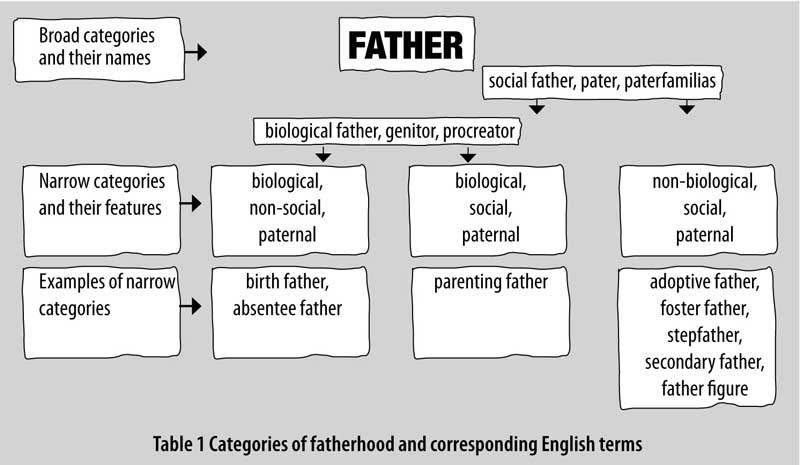
figure 1

Table 1 Categories of fatherhood and corresponding English terms


It is crucial to note that social father and biological father are overlapping categories, and a parenting father is in both categories. So a man can be described as a child’s social father without implying that he is the child’s biological father as well, even if most social fathers are also the biological fathers of the children they raise. In Luke 2:48–49, both Joseph and God are called in Greek Jesus’ patêr “social father.” Since neither one passed DNA to Jesus, the paternal relationship was not only social but also non-biological.

As shown in table 1, the English word father is broad in meaning and not necessarily biological, since one can be a father to someone without having sired him or her. In some languages, however, the word commonly used for a paternal family member is limited in meaning to biological father, so it is not used of a stepfather or adoptive father. In the translation read by the woman above, the word used to translate patêr “social father” actually meant biological father; this implied that Joseph had sired Jesus and hence that Mary was not a virgin when she conceived him. It was not an accurate translation.

A similar distinction exists between social son, which signifies a filial social relationship to a father, and biological son, which signifies a filial biological relationship to the source of one’s paternal genes. Again, in a typical situation the same person has both relationships; a parented son receives his DNA and paternal nurturing from the same man. In some situations, however, this is not the case; Jesus received paternal nurture from Joseph but did not receive DNA from him. These categories are shown in table 2.
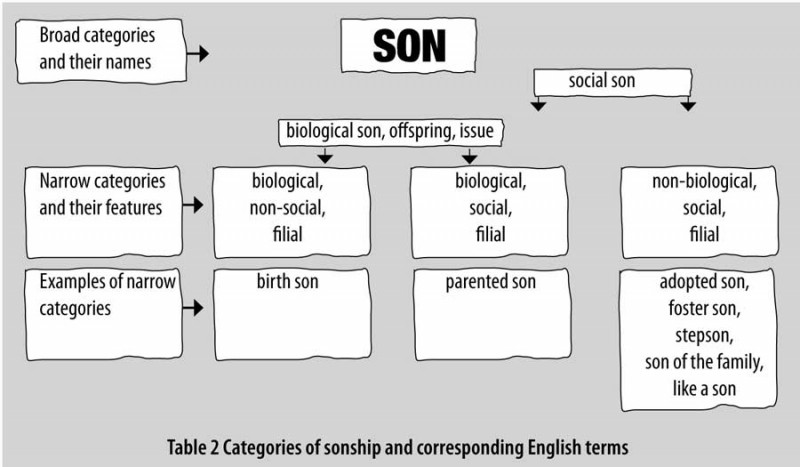
Table 2  Categories of sonship and corresponding English terms


The English word son covers all three categories, but in some languages the word commonly used for a male child of the family is limited in meaning to biological offspring. Such a word does not accurately describe Jesus’ relationship to Joseph.

Biblical Greek and Hebrew have one set of terms signifying social familial relationships, similar to English father and son, but with broader application, and a second set for biological familial relations, like English procreator and offspring.2 In a nurturing biological family both sets of terms apply to the same people. A stepson, however, is not called a biological son, and a disowned biological son is no longer a social son. 

It is important to realize that to express divine familial relationships, the Bible uses the Greek and Hebrew social familial terms, not the biological ones. It presents the essence of God’s fatherhood of us in his paternal care for us as his loved ones rather than in siring us as his biological offspring. 

While in Hebrew and Greek the social familial terms are the ones commonly used to refer to members of one’s family, in some languages the biological terms are most commonly used. Other languages, like Arabic and various Turkic languages, lack a set of social familial terms, and neither adoption nor step relations are recognized, so to convey a non-procreated familial relationship one must use a phrase, such as like a father to me, or use a term for paterfamilias (head of family). When translating the Bible into such languages, it would be inaccurate to translate the Hebrew or Greek word for a social father or son using a word for a biological father or son in the target language unless the relationship is truly biological. This is especially the case with regard to the Father-Son relation, which was generated non-biologically, without procreation. Translating Father and Son with biological terms has caused readers to think the text claims that Jesus is the offspring of God procreating with Mary, and this has caused Muslim readers to reject such translations as corrupt and even blasphemous.

Problems with Mixing up Biological and Social Familial Terms

It is the task of Bible translators to communicate “the meaning of the original text…as exactly as possible…including the informational content, feelings, and attitudes of the original text” by re-expressing it “in forms that are consistent with normal usage in the receptor language.”3 It might seem astounding, therefore, that Bible translations would ever use expressions that misrepresent the divine relations by implying they arose from sexual procreation. However, this has happened in the history of Bible translation for two reasons. One is that translators have historically preferred word-for-word translations of key biblical terms. Some translators are under pressure to do so even if it misrepresents the meaning, as it can when the target language requires the use of a phrase to express a non-biological familial relation. Another reason is that some translators simply used the most common words in the target language for all familial relationships, even if those words were biological in meaning and a different, specialized term was required to express the social or non-biological relationships in the family of God. 

The reality is that there are usually semantic mismatches between the words in any two languages, especially if they are from different language families and different cultures, and translators often have to use phrases in the target language to express the intended meaning of a single term in the Greek or Hebrew text. Not understanding this, some well-intentioned Christians have insisted that the Bible translators in other countries produce word-for-word translations of familial terms because they mistakenly assume that every language describes familial relations in the broad sense expressed by the common English, Hebrew, and Greek familial terms. But that is not the case, and the common, single-word terms used for family members in some languages are strictly biological and are inappropriate for describing the family of God. The problem is that these translations end up attributing a biological meaning to the fatherhood of God, implying he reproduced the Son, the angels, or even the spirits of people through sexual activity. This meaning was not communicated by the original-language expressions, and it conflicts with the intended meaning of the text.

This mistake results in readers understanding the Lord’s Prayer to say “Our Begetter, who is in heaven,” and understanding Jesus to be “God’s (procreated) offspring.” The “longing of creation” (Rom 8:19) is understood to be “for the revealing of God’s biological children.” Such wordings are inaccurate because they add a procreative meaning that was absent from the original, and they sideline the important interpersonal relationships that were expressed in the original text.  Readers from polytheistic religions readily accept that gods procreate with goddesses and with women, and they assume the phrase Offspring of God signifies a procreated origin. Readers in many Muslim language groups understand Offspring of God in a similar way, namely that it means God had sexual relations with a woman; unlike polytheists, however, they reject this possibility and consider the phrase to be a blasphemous corruption of the Bible that insults God by attributing carnality to him. They fear that even saying such a phrase will incur the wrath of God. These misunderstandings disappear, however, when translators express the divine familial relationships in ways that do not imply sexual activity on the part of God. Muslim readers and listeners can then focus on the message without being preoccupied with the fear of attributing carnality to God, and when they do, they recognize that the deity and mission of Christ is evident throughout the Gospels. This highlights the fact that translators are not trying to remove original meanings from the translation that might offend the audience. On the contrary, their concern is to avoid incorrect meanings that fail to communicate the informational content, feelings, and attitudes of the original inspired text. 

Some Possible Translations for Father and Son of God

If translators wish to avoid those mistakes and express the divine familial relations in non-biological terms, then what expressions can they use? 

  1. Obviously, in languages that have single words for social fathers and sons, if phrases like our Father and sons of God are understood as signifying God in his caring, paternal relationship to us as his loved ones, without implying a claim that God produced our bodies or spirits by having sex with females (as even Mormons claim), then these expressions are to be preferred.
  2. In some languages where the commonly used kinship terms are biological, there are also social familial terms similar in meaning to paterfamilias and loved ones (meaning one’s beloved family), and Christians use these to describe God’s paternal relationship to us and our filial relationship to him.
  3. Where such terms are not available, it is sometimes possible to say something like our God in heaven, who is like a procreator to us, and we are like offspring to God. On the other hand, a phrase like God’s loved ones may be better at conveying the loving nature of the relationship. 
  4. To describe the Father-Son relationship, some languages add a word that helps block the biological meaning of the words, using phrases equivalent to Offspring sent from God or Spiritual Offspring of God. 
  5. Some languages have terms for a favorite son, only son, firstborn son, or ruling-heir (who is usually the firstborn), and people use these for the Father-Son relationship, as in God’s Loved One and God’s Only One. The Greek New Testament uses terms for Jesus equivalent to all four of these, but it also has a term for social son, huios, that is used more often. Unfortunately many languages lack a term equivalent in meaning to huios. 

Translators ask people from the intended audience, both believers and others, to read or listen to passages of Scripture in which these alternative wordings have been used; then they ask them questions to find out what they understood these phrases to mean in context. Based on this feedback from the community and feedback from other stakeholders, the translation team and the local editorial committee, with the help of an outside translation consultant, decide which translation is best. There may be several cycles to this testing phase until the best solution is found.

Using the Paratext

The authoritative text of Scripture is the one God communicated to us in Hebrew, Aramaic, and Greek. The task of translators is to enable readers to understand the message that God communicated via this original text. Because of differences in language and context, to communicate God’s message in another language requires both text and paratext. The paratext can effectively define the biblical meaning of an expression used in the translated text as long as that expression does not already mean something contrary to biblical meaning.

The paratext consists of any introductory articles, footnotes, glossary entries, and parenthetical notes in the text that the translators wrote as an integral part of the translation to explain terms, unfamiliar concepts, and essential background information. So even if translators find a way to express divine fatherhood and sonship in the text, it is also important to fill out the meaning of the expression in the paratext. In a non-print Scripture product, the paratext consists primarily of introductions to sections of text. So what should be included in the paratextual explanation of Son of God? 

Components of the Meaning of Son of God

Church history and contemporary scholarship emphasize two components of meaning of the term Son of God: 

  • Ontological (as the eternal Son he is consubstantial with the Father and eternally generated from him in a non-procreative way; Heb 1:3); and 
  • Mediatorial (as Son of God he is sent by the Father to mediate God’s rule, grace, and salvation to his people, to impart sonship to them, and to be their Savior and Advocate). 

Bible scholars suggest that the mediatorial meaning is the most prominent in many contexts of Scripture, but they also recognize that the Bible uses the phrase with six additional components of meaning: familial/relational, incarnational, revelational, instrumental, ethical, and representational. All these can be explained to readers in the paratext, usually in a mini-article, in the glossary, and in footnotes. While the mini-article goes into depth of meaning, the explanatory notes remind the audience that the phrase “Son of God” does not mean God’s procreated offspring but means that he is the eternal Word of God (ontological and revelational), who entered the womb of Mary (incarnational) and was born as the Messiah (mediatorial), and relates to God as Son to his Father (familial).

Preference for the Familial Component of Meaning

Although the concept signified by Son of God is rich in meaning, there are advantages to expressing the familial component in the text and explaining the other components in the paratext. This provides for consistency among translations and consistency with church tradition. More importantly, it is primarily the familial component of divine sonship that Christ imparts to believers, and he is the “firstborn among many brothers,” all under the paternal care of God as loved ones in his eternal family. This is not easily communicated if the familial component of Son of God is not expressed directly in the translated text.

Although Bible scholars agree on the prominence of the Mediatorial meaning of the term Son of God in most New Testament contexts, yet because of the advantages of expressing the familial component in the text, it is clearly best to do that and to explain the mediatorial and other components in the paratext. In particular, we believe mediatorial terms like Christ or Messiah should be used only to translate Greek Christos and should not be used to translate words like Son.

Clarifying Some Misperceptions

There have been a number of misperceptions about the translation of divine familial expressions, especially in languages spoken by Muslims, and these have been aggravated by the current level of tensions in the world. The explanation above clearly states that this is a linguistic issue, in which translators seek to communicate the social familial meanings of the Greek and Hebrew expressions while avoiding the wrong meaning that God reproduces children through procreation. This is the meaning of accuracy in translation. But it might be helpful to address the misperceptions as well:

Contrary to what some people imagine, the use in translation of non-biological expressions for Father and Son

  • is not imposed by outsiders, but is decided by believers in the language community;
  • is not limited to languages spoken by Muslims but is a challenge for any language in which the normal kinship terms are biological in meaning and imply procreation;
  • is not intended to lead audiences into any particular form of church, whether Protestant, Catholic, Orthodox, or “insider”;
  • does not itself constitute an “insider” translation or even a “Muslim-idiom” translation;
  • is not contrary to normal translation principles but seeks to follow them, by using phrases to translate the meaning of Greek and Hebrew terms that lack a semantic counterpart in the target language, and by explaining the meaning of the terms in the paratext;
  • is not limited to “dynamic” translations but is used in more “literal” ones as well;
  • is not contrary to how conservative Biblical scholars interpret the Greek and Hebrew expressions but rather seeks to follow their scholarship;
  • is not intended to change or obscure the theological content of Scripture or make it more palatable to the audience, but seeks rather to convey it as accurately as possible;
  • does not hinder the audience’s perception of Jesus’ deity but rather facilitates it;
  • does not stem from liberal or unorthodox theology on the part of translators or from a liberal view of Scripture, but from interaction with the interpretive and theological tradition of historic Christianity and the results of contemporary conservative scholarship, with the goal of communicating the verbally inspired message of the Bible as fully and accurately as possible.

Various Bible agencies are seeking to explain translation principles and dispel these misperceptions. Wycliffe Bible Translators (USA), for example, includes the following point in its statement of basic translation standards:

In particular regard to the translation of the familial titles of God we affirm fidelity in Scripture translation using terms that accurately express the familial relationship by which God has chosen to describe Himself as Father in relationship to the Son in the original languages.4

It is not accurate to use expressions which mean Jesus’ sonship consists of being the offspring of God’s procreation with a woman.

Conclusion

In order to accurately convey divine fatherhood and sonship, translators need to use expressions that are as equivalent in meaning as possible to the Greek and Hebrew terms for social son (huios and ben) and social father (patêr and âb) and to avoid biological expressions of the form God’s Offspring or the Procreator of our Lord Jesus Christ, because these are understood to signify biological relations generated through a sexual act of procreation. In this way translators can enable new audiences to understand the biblical sense in which God is our father and Christ is his son, as well as understand the relationship of Joseph to the boy Jesus.

Ultimately it is comprehension testing that plays the crucial role in the process of translation, because there is no other way to ascertain what a particular wording in the text and paratext actually communicates to the audience or to discover which wordings communicate most clearly and accurately. That is why translators and churches “test the translation as extensively as possible in the receptor community to ensure that it communicates accurately, clearly and naturally.”Across the world, this approach to first-time translations has been found repeatedly to offer the best success at enabling new audiences to comprehend the biblical message and to respond in faith, as God enables.


Endnotes
  1. We gratefully acknowledge the helpful input, feedback, and support we received from many translators and other interested parties, and from Bible scholars such as Prof. Vern Poythress of Westminster Theological Seminary and Roy Ciampa of Gordon-Conwell Seminary.

  2. See "A Brief Analysis of Familial Terms in the Bible" in The International Journal of Frontier Missiology 28:3 (2011).

  3. Forum of Bible Agencies International, Basic Principles and Procedures for Bible Translation, PDF.

  4. See www.wycliffe.org/TranslationStandards.aspx.  See also www.wycliffe.net/Missiology/BibleTranslationandMission/tabid/94/Default.aspx?id=2213, http://www.wycliffe.net/AboutUs/PositionStatements/tabid/97/Default.aspx?id=2396, and www.missionfrontiers.org/blog/post/bible-translations-for-muslim-readers

  5. FOBAI, Basic Principles.

Comments

Thank you for a comprehensive and balanced explanation of the issue.

Thank you to the authors and to MF for publishing this timely, balanced and very understandable article concerning a crucial topic in our day. I very much appreciated the excellent background information provided and the way that misperceptions were addressed. My family and I lived for more than twenty years in Muslim neighborhoods and often tried to read scripture with Muslim friends.  It was always difficult to find a way to translate or explain to them the term Son of God. This article provides an excellent framework from which to approach this tough translation question.

John Jay Travis, Ph.D.

Thank you for a very careful, thoughtful and helpful discussion of a very important and complex issue. If only Bible translation were as simple as so many people think it is! Your concern that the intended readers not be led to construe illegitimate and unhelpful meanings (ones that most of us would never consider due to our own linguistic and theological backgrounds) is certainly valid and your recommended approaches to avoiding that problem will be helpful to all who wrestle with this problem. Certainly your attention to the crucial role of informed leaders in the language community in making these decisions is an important corrective to past practices where all such decisions were made in a paternalistic manner by people outside those communities. Thanks again for your important work on this difficult issue!

.....so helpful to see such a careful thinking through of the issues involved in translation. Understanding meaning from another cultural framework is absolutely crucial in being faithful to the word of God while translating. Good communication is always the responsibility of the sender more than the hearer. This article really provokes us in taking responsibility and care for what is being communicated in our translation work. Having worked for over 12+ years in both Hindu and Muslim contexts has sensitized me all the more toward this issue, beyond the theory.

This is a very clear explanation of a complex issue that is often misunderstood by people who only work in one culture. After 40 years of working in the Hindu/Muslim/Buddhist and Shinto worlds, one becomes more sensitive to the dilemmas of translation work and the misunderstandings that take place. I strongly affirm Rick Brown’s efforts to help the layman understand what the issues are and to help us appreciate that the only goal in mind is to help the person from the Muslim community understand the Good News in a way that we have undestood it in the English speaking world.

In 35 years of working with Muslims, this is one of the clearest articles I have read that explains to those who have not had cross-cultural experience the cross-cultural issues involved in translation of familial terms. Thank you so much for clarifying the issues of Bible translation from a conservative, evangelical, Bible-honoring perspective.

I appreciate that this article is in print and available to help people wrestle with these issues in a deep and faithful way. Translation is rightly a matter of deep concern for all involved in the mission calling of the Church. God has given us the scriptures and continues to shape and correct and instruct His people through them. Making the meaning available and accessible to all people is a crucial task for mission and this article helps to shed light on that task. Kevin

Thanks for this patient and crystal-clear explanation, Rick. And of course the principles and methods you discuss here in reference to familial language, apply to a myriad of other issues in the translation of the Scriptures. Your opening example involving the ESV could be multiplied many times over! Great choice!

If the Father-Son language is so problematic for Muslims, then I guess the churches of the Muslim world are very glad with changing those terms in the Bible?

Here in Egypt, be assured, the churches are NOT happy. They fully r

If the Father-Son language is so problematic for Muslims, then I guess the churches of the Muslim world are very glad with changing those terms in the Bible?

Here in Egypt, be assured, the churches are NOT happy. They fully reject this as tampering with the Bible.  And they kindly ask organizations like wycliffe to respect the role of the national churches: we here are responsible for presenting the Gospel,and we are quite able to explain our Bible to anyone. We do not need foreign Bible translators to tell us what sort of adapted Bibletranslations we need.

And suggesting that in Arabic terms like Father and Son always have sexual connotations is untrue.  Arabic uses the terms in many situations without any sexual overtone.

And finally, Father-Son language in the Bible is used to suggest the most intimate link between the Creator God and the Word that was generated eternally from God.  The Bible uses those terms Father and Son to underline this most intimate link.

Why do Muslims reject Filial terms regarding God? Because their Koran and their theology rejects those terms.  A flimsy reason to tamper with the Bible, I’d say.

Thank you!

Mr. Brown.  If one thing is crystal clear it is your identification of the lady’s problem at the opening of your article. Her problem, according to you, is intellectual. Only so. To me it is crystal clear that your anthropology might be sub-Biblical. Ouch. How can I say that? You sketched out the fact that a “non-Christian” read a portion of the Bible and rejected it. This conforms exactly to a Biblical anthropology. We expect that the unspiritual person will reject spiritual truth according to the Bible. However, you state that her problem is not being dead in sin, hostile to God, at enmity with God, suppressing the truth in unrighteousness—all Biblical categories I might add—-but that if the text were made more user-friendly she would accept its content. Do I hear echoes of Pelagianism? Hate to say, but the data seems to suggest it. Mr. Brown, consider this. A dead person in a cemetery objects to the writing on a tomb-stone. Response. The cemetery keepers jump to change it. A group of bystanders applauds the change as making things “crystal clear.” Is there a problem here?
Shalom

It appears to me that Salaam Corniche is responding to Mr. Brown on the basis of a false understanding of the woman’s response in Brown’s example. Can we all agree that, if a portion of translated Scripture is mistranslated, i.e., delivers the wrong message, then in fact that translation cannot properly be called a part of “the Bible” at all? Can we agree that the only valid “Bible” to which one might rightly respond (by acceptance or rejection of the message) is that Bible which delivers the message as God intended it?
We can have only four message-response possibilities:
1. True translation > Acceptance (Sparking faith unto salvation or spiritual growth)
2. True translation > Rejection (Dead in sin, hostile to God, etc.)
3. False translation > Acceptance (Faith on a false foundation resulting in cultism, etc.)
4. False translation > Rejection (Intellectually honest and possibly spiritually discerning)
Corniche seems to believe that the example is illustrating situation #2, when Brown was clearly describing an example of situation #4.

Craig
You hit a nail on the head. By your definition, the interpretive constructs that are being forced on the text, i.e. “beloved son from God”/ “offspring sent from God” to replace the name Son of God, constitutes a false translation. By your definition, one who would accept this construct would be led into cultism etc. Voila. You have clearly identified the logic chain. False translation—-leads to->>some kind of acceptance->>leads to cultism. Why are some so adamant against this type of theological experimentation? You answered the question yourself. 
  I do not think you responded to the presuppositions of Mr. Brown, however. This is really the critical area, as Mr. Brown will continue to pull more authorities out of his hat to defend his position. We need to get farther down in the basement and see where this is coming from.
Shalom.

The task of translators is undeniably difficult, one that the authors correctly recognize. It is indeed challenging, for example, to translate “snow” for a tropical language group that has no word for it. But translating Isaiah 1:18 with something like, “your sins shall be as white as coconut milk” at least retains the theological meaning of the verse.

However, translating the identity and nature of God himself is in a completely different category. Using terms other than “Father” or “Son” for God actually loses the theological meaning of God’s own Word. God eternally exists as Father, Son, and Spirit—and these terms reveal who God is in his person. As theologian John Murray says, these distinctions are “necessary, intrinsic, and eternal.” The eternal distinctions of the Godhead are “necessary” in that there is no Trinity without them. The terms thus are not mere metaphors, like “snow.” Father, Son and Spirit are who God is. Other terms simply do not capture God’s essence, and to use non-familial terms is to make God exactly that: non-familial. And despite what the article claims, my Arabic and Turkic (and Bengali) friends say that “Son of God” does not equal “Sex with God.”

The starting point for any translation is not “what does the audience understand?” but “what did the author say?” In that, God has clearly spoken, and we have no alternative than to be faithful to what he has said: “we have seen and testify that the Father has sent his Son to be the Savior of the world. Whoever confesses that Jesus is the Son of God, God abides in him, and he in God.” (1 John 4:14, 15). May the world indeed—Muslims included—know that God the Father sent God the Son.

The authors are imposing two categories on the use of “Son of God” and “Father” in the Scriptures and forcing the unaware reader to adopt one of either “biological” or “social” interpretations.  The reader should ask, “where did ‘Son’ and ‘Father’ originate?”  If the answer is that these originated with Adam and Eve’s experience as they became the first family . . . then fine.  You are then free to chose between one of these two categories and accept that the terms in Scripture are metaphors that God uses to help us to understand Trinity.  If, however, you believe as I do that they originated in God Himself and our human experience of ‘Son’ and ‘Father’ are derivatives of what existed in the Godhead prior to creation then . . . you should think twice.  Are these categories ones that we are taught to use in God’s self-revelation or are we imposing them on God based on our own experience as humanity of what it means to be ‘Son’ and ‘Father’?  Who gets to decide what ‘Son’ and ‘Father’ mean in the Godhead?  Reader, beware!

From ‘Redeeming Sociology’ by Vern Poythress (available online http://www.frame-poythress.org/Poythress_books/Redeeming-Sociology/2011Redeeming.Sociology_Final.pdf):

Many people take their starting point from human personal relations. They reason that we first know about earthly fathers and earthly sons. Then, by some kind of leap or extension, we project the earthly personal relationship of father and son into the sky, and we talk in a metaphorical way about God as “Father.” . . . But we should rather think through our own human relationships with God as our starting point. After all, he is the original. We are derivative. The original father is God the Father. Any earthly father is “father” only by analogy to the ultimate Father. . . Human fathers and human sons exist and their family relations exist only because we are made in the image of God, who is the original Father.

If I might be so bold as to distill the article and all subsequent comments down, it seems there are two areas of emphasis. Either it is receptor sensitivity or Revealer sensitivity. The first, in the name of love and sensitivity to Harry and Mary and their over-inflated egos—as people who are dead and sin and outside of Christ are—-seems to have few theological controls to its perpetual appeal to pragmatism, and its praise of humans engendering quality of “look how clever we are.”

Love does care about the other, but to what degree? It is always subordinate to the second, namely Revealer sensitivity. The preoccupation of such is that the reputation, the honor, the portrayal of who He is on His terms,is the Biblical preoccupation and should be ours. We cannot and will not play around with the name of His Majesty, “The Son,” nor His Majesty “The Father.” These are not social relations in the first place, they are the titles of The God of Glory in all of His Majestic and awe inspiring Holiness. Maybe a recall of Isaiah 6, Ezekiel 1 etc would push us to ask His Holiness what He wants to be called.   

My position is that you cannot remove the terms God has chosen to use
without destroying the continuity of the biblical message. What is implicit
in the OT is made explicit in the NT. The removal of the terms Father, Son,
and Holy Spirit will essentially change the entire nature of the NT message
because it changes the definition/description of God. It removes the
structure (so to speak) in which the Son operates. It removes “God with us.”
It returns us to a strict monotheistic position without understanding the
nature of the one God. In effect, it takes us to a god of a different nature
who is not the God of the Bible.

Blessings,
roger

Being a former Muslim and now an Ordained minister of the Gospel and a missionary to Muslim for over 20 years, I have never heard of such a Satanic molastation of the Original language of ‘Father and Son’ in the Word of God. I was Baptised in the name of the Father and of the Son and of the Holy Spirit.  Any translation that takes away from the ‘Father and Son’ BAPTISMAL LANGUAGE IS FROM THE DEVIL HIMSELF WHO TRIES TO CRAFT HIS OWN LANGUAGE.  Mr Brown is flirting with the Devil and he does not know it. You might as well remove the Holy Spirit in the trinity and put your name instead to help the dead in spirit understand the true meaning of the Inspired words ” Father and Son”
If you only know the true meaning of the first two words in the Lord’s Prayer” Our Ftaher” your whole life will change again and then you will learn to trust in the Power and leadership of the Holy Spirit and trust in the Original Words of the Trinity.

You are messing with the Devil and you don’t know it, but i will continue to pray for you son.

As I read many of the comments posted here I am am forced to wonder whether the critics of this article have actually read and carefully considered what the article actually says or whether they are simply reacting out of fear to a figment of what they think it is saying.

The authors of this article are simply advocating for translating the Scriptures into the words and phrases of other languages that most accurately communicate the original meaning of the words of the original Greek and Hebrew words. What may I ask is wrong with that. Is this not the job of the Bible translator regardless of what language the Scripture is being translated into. Translation is an essential and ongoing role for the church because every language is constantly changing. It requires the highest degree of academic professionalism and attention to detail. Wycliffe and other Bible translator organizations have demonstrated this over many generations. Instead of believing the worse of them and attacking them, the critics should study long and hard what they do and understand the complexities of translating across language barriers rather than jumping to conclusions.

So if carefully and accurately translating words from the original Greek and Hebrew is not an acceptable standard for the critics, what standard do they propose be used. The critics seem to assume that this article advocates for translating the original Greek and Hebrew words with meanings that are different from the original. This is not what the article says. Read it again.

Translation begins with reading what the author wrote, which is the Hebrew or Greek text. These are the words that God chose, Greek and Hebrew words, not English or Arabic words. Translation proceeds to what that text meant in the language and context. This is exegesis, to find the true meaning of the words, phrases, sentences, and overall message. Bible scholars write about this, and translators remain within the bounds of conservative biblical scholarship. The next task is to communicate the original meaning in the target language. This involves analysis of the target language and comprehension testing of draft wordings, to ascertain what they mean in that language and to ensure accuracy of meaning.

God has used familial terms, among others, to reveal his internal Trinitarian relations and his external relationships. The Greek and Hebrew terms that God used are generic or social kinship terms, meaning the relationships are not necessarily biological. That makes them very fitting to denote positive ongoing relationships and for eternal generation and adoption. (The Greek and Hebrew terms and the generative aspects are discussed in “A Brief Analysis of Filial and Paternal Terms in the Bible,” which will appear in the next issue (28/3) of the International Journal of Frontier Missiology.)

The most accurate translation is one that uses words and phrases with meanings as close in meaning and usage as possible to the originals. How do translators ascertain which phrases and sentences are closest in meaning? By observing their usage in speech and texts and by testing draft passages to find out what they actually mean in context. Since words and phrases can have different meanings in different contexts, it is essential to test whole passages. When testing alternative wordings for the phrase we know in English as “Our Father,” translators and their various church and mission partners discover that some expressions are closer in meaning than others, and so they use those. A translation that means “our Begetter in heaven” might not be the closest in meaning to the original, especially if it fails to convey an ongoing fatherly relationship.

These are normal principles and procedures. The Forum of Bible Agencies International provides a list of “Basic Principles and Procedures for Bible Translation” at www.forum-intl.org/uploadedFiles/about_ifoba/Translation Standards.pdf Readers might want to look at that.

There are Christians in some languages who have become accustomed to “our Begetter in heaven,” understand its intended meaning, and are strongly attached to it. That is fine for them, but there are other Christians who want something more accurate, especially for outreach. The wider audience of seekers might also be demanding a more accurate translation. So churches, missions, and Bible societies have been seeking to meet that need. This gives people the freedom and opportunity to choose which translation they prefer to use. Should they be denied that opportunity, just because some people prefer a traditional wording? There are people who prefer the King James Version, which is fine, but a few of them oppose the availability of all other translations and say they are of the devil. That is their opinion, but other people are entitled to have their own opinion and to have the freedom to choose the translation they regard as best.

Mr Brown, I appreciate the hard task of good translators.

But what gives translators of the bible the right to act against the expressed opinions of church leaders in the lands where translations are made? 

And can you for the sake of clarity explain why you continue to suggest that in many Muslim languages familial language about God as Father of the Son Jesus Christ has sexual overtones?  I know my Arabic quite well, and in Arabic it is certainly not the case.

I have heard the argument about the sexuality in the language of Father and Son so often now, but the repetition of an argument does not make it true. 

And even if the language has some sexual overtones, is that such a problem?  The task of the church is to explain the Gospel.  Please allow us to do this, you do not have to make it easy for us.

Muslims, by the way, usually misunderstand many other aspects of the Bible as well.  Why do many immoral stories? Let us translate them a bit nicer?  Why are the testimonies of the resurrection of Christ seemingly contradictory sometimes? Why not smooth this over?  Etc etc etc.

Number of people in the world with a father: 7 billion.

Number of people who refer to or think of their father as “my begetter”: 0

Value of knowing God as Father: Priceless


Let’s keep Father in the Bible, just like God said, who wants all of us to know him as Father.

Muslim theology rejects the fatherhood of God, the deity of Jesus Christ and the personhood of the Holy Spirit- each of which is an essential component of the Christian understanding of God.  Any Translation that changes the words “Father and Son” language in the Trinity corrupts the Saving and transforming work and power of the Christian God that I came to know litterly and spiritually in those two sweet words.  No devout Muslim can call the God of Muhamed ” Father” and Jesus ” His Son” apart from the Work of the Holy Spirit.  So leave it up to Him to do his work and get out of his way.
No faithful Christian can refuse to confess with joy and confidence, ” I believe in God the Father Almighty and in Jesus Christ His Son!”  As a former Muslim, apart from my Confession of the ” Father and Son in the incarnation, it was possible for me to know that God is but not who God is.  Is the Father of Jesus the God of Mohamed?

Referring to Dr. Brown’s comment above:

“There are Christians in some languages who have become accustomed to “our Begetter in heaven,” understand its intended meaning, and are strongly attached to it. That is fine for them, but there are other Christians who want something more accurate, especially for outreach.”

I believe that it is incumbent upon him to provide specific examples of existing Bible translations that use “our begetter in heaven.”

Mr Wood and Mr Brown
  Consistently your responses both defend the arduous work of translators which I can appreciate. However, I think you have brushed off your critics under the guise of professionalism, global use of new terms on the terms of receptors and an appeal to Hebrew and Greek, while attempting to make yourself smell like roses. No one is arguing about the Hebrew and Greek.  Like it or not translators come to the task as theologians who carry their presuppositions with them. This is the issue at hand. If you presuppose that novelty is most admirable, your translation will reflect it. If you presuppose that the receptor is king, your translation will reflect it. If you presuppose that you must help out the perspicuity of scripture by adding some of your great wisdom, then your translation will reflect it. If you presuppose that the church and the Holy Spirit needs a “little help from his friends”, then your translation will reflect it. If you presuppose that lack of information is the basic human problem, then your translation will reflect it. Please for the glory of God, subject your presuppositions to Biblical analysis.
Shalom

Rick Brown,

I think the difficulty that most have with these new translations are that the linguistic basis for these translations has been continually asserted but never been demonstrably proven. Native Arabic speakers seem to be entirely unaware of the “sexual/biological” limits of ‘ibn’ whether they be Muslim or Christian.

When we deal with the very specific question about what Muslim’s believe that Christians teach regarding God’s relationship to Jesus then the misunderstanding you describe does present itself, but the basis for this misunderstanding is theological in nature and is the result of teaching within Islam related to this very specific topic; it does not appear to be a general misunderstanding of the term ‘ibn’ caused by the more narrow semantic range of meaning that is so often asserted. Muslim’s do not seem to have any difficulty understanding a broader semantic range when using this same vocabulary to refer to people in other cultures that have “sons” whom they have adopted, nor do they have difficulty understanding idiomatic usages that do not convey a “sexual/biological” relationship. Some older Islamic literature even refers to “Zayd ibn Mohammad” i.e. Mohammad’s adopted son and Muslims have no difficulty recognizing that Zayd is not biologically related to Mohammad. Before one can argue that a translation needs to change because of a linguistic misunderstanding of the langauge itself, one needs to first demonstrate that the linguistic misunderstanding actually exists.

The issue on Father and Son in what that woman cannot accept was not a problem at all for any preacher
of the gospel because it is NOT the gospel. Stick to your job preacher and leave others to the translators. In fact contextually speaking,Jesus corrected Mary in connecting him to Joseph as whether social nor step father as we may call it. That unbelieving lady need to read more so she can understand what the Spirit of God is saying. There are people for years been reading the bible yet never came to faith because they do not understand it. why ? ask the Holy Spirit.PREACH THE WORD!

I think if Mr. Brown wants to protect Muslims from “sexual” Biblical images, he should start with the term “Bride of Christ.” Should we obfuscate that image as well, or should we surrender to the divine wisdom that says the term “bride” (in every language) is merely the temporary allegory while the term “Bride of Christ” portrays the eternal reality?
I have been called “uncle” and “big brother” by many Turks, and I can assure you that none of them implied any sexual relations between our ancestors. I do not speak Arabic, but I cannot imagine that the use of “son” differs greatly from Hebrew. Did God not expect shock and awe among the Pharisees when Jesus referred to Him exclusively as “Father?”
An evangelist should attempt to remove stumbling blocks, but not the Stumblingblock.
If I am to believe that this is not “imposed by outsiders” as stated in the misperceptions, then I will need a link in the endnotes to statements of support by associations of Turkish churches, etc.

The angel replied, “The Holy Spirit will come upon you, and the power of the Most High will overshadow you. Therefore the child to be born will be holy; he will be called the Son of God.”(Luke 1:35)

Jesus replied, “I am the way, and the truth, and the life. No one comes to the Father                             except through me. If you have known me, you will know my Father too. ( John 14:6-7)

For this is the way God loved the world: He gave his one and only Son, so that everyone who believes in him will not perish but have eternal life. For God did not send his Son into the world to condemn the world, but that the world should be saved through him. The one who believes in him is not condemned. The one who does not believe has been condemned already,                                because he has not believed in the name of the one and only Son of God (John 3:16-17)

There will be no any possibility to avoid of giving of account to the Triune God – Father, Son and Holly Spirit, if anyone does change that concept in the Holly Bible! The concept is equal valid to any human being on the planet earth, including those for whom it might be seen as a stumbling block. We either accept the concept or reject it. There is no midle way! It is Him in fact, Who has decided it! We do not chose the concept but only if we do believe it or not!

Can someone answer whether these translators affirm the innerancy of the Scriptures? Is there any translation group that requires such a commitment from its translators? It is easier for those with a low view of Scripture to substitute words and phrases one hopes is cukturally sensitive.

[tired sarcasm follows]

.....I am so glad that God has Wycliffe’s dynamic equivalence theory and Rick Brown to correct His own clumsy inspired text, and I am glad that we are willing to change the standard of what constitutes a good translation from the old standard of accuracy with the original text to the new post-modern standard of acceptability by unbelievers in the name of “accessibility.”

The contemporary Wycliffe-sponsored Lives of the Prophets takes out “Son of God” and replaces it with other terms in a number of places which seem highly inappropriate:


From Lives of Prophets;
(http://www.answering-islam.org/fileadmin/reviews/lives-of-prophets.pdf)


The Spirit of God will come down
upon you and this thing is the proof
that this child is the awaited Christ
who will rule forever.

Luk 4:3; If you are truly the Messiah of the Most High God, command these
stones to become bread.

Luk 4:9; Afterward, the Devil took Him to Jerusalem and stood Him on the edge
of the House of God. If you are truly the Messiah of God, throw yourself
down from up here

Luk 11:2; When you pray, say: Our loving, heavenly Lord


“Huios tou theou” - How does one get Messiah out of that?

Πάτερ, ἁγιασθήτω τὸ ὄνομα σου - How does one mistake Kurios for Pater and mistake “heavenly Father” for “Heavenly Lord?”


A common Muslim expression is “Ibn is Sabil” - or “son of the road.”  Despite this phrase occuring several times in the Qur’an itself(Surah 8:41; 9:60; 17:26; 30:38; and 59:7) and being in common usage among Muslims, I know of no Muslim who believes that someone had sex with a road and had baby roads. 

And yet Huis Tou Theou MUST be exchanged for another phrase lest people misunderstand who Jesus is?

Also, many Egyptians refer to themselves as “Ib in Nil” or a son of the Nile without any biological/sexual misunderstandings.

And yet Huis Tou Theou MUST be exchanged for another phrase other than the inspired original “Son of God” lest people misunderstand who Jesus is?


Amen to Pastor Seaton’s reminder: “The starting point for any translation is not “what does the audience understand?” but “what did the author say?”


Is this a case of “traduttore, traditore?”

I appreciate the thoroughness of the presentation yet is is flawed in in its basic conception.  I would point out that in English “son” refers only to a biological son.  We use modifiers to qualify the relationship:  “foster-son”, “step-son”, “adopted-son.”  Yet the scriptures themselves are faithfully rendered saying that Jesus is the son of God and it also refers to him as the son of Joseph.  While it requires some explanation yet faithfulness to the original languages demands it.

Following is a very well researched paper highlighting the full depth of the misconceptions presented by Andrea and Lea Gray, Rick Brown’s article:

http://biblicalmissiology.org/wp-content/uploads/2012/01/LostInTranslation-FactCheck.pdf


Good day fellow truth lovers:
  As I was musing on things, it came to mind that there is an underlying assumption that if objections are removed, then people will come. Frankly this is more the language of marketing than of the Bible. Think about the verse from Acts 13:48   “...and as many as were appointed to eternal life believed.” Now take the above Gray-Brown proposal to re-write the verse to say: “...and as many as had their objections removed believed.”
  In the first case, it is the Divine choice that precedes belief. In the second case, it is the human manipulation of the text that precedes belief.
  If you want a human-centered gospel, where humans get the glory for their work—which incidentally replaces the effectual calling of the Holy Spirit, where humans are credited for their wise choice for the gospel as objections are removed by other wise persons, and where the Almighty Father is reduced to a super-human ‘begetter’ and his Majestic Son reduced to a super-human ‘proxy’ then through the hallways of time the words J.B. Phillips will echo as your legacy: “Your God is too small!”
  I think of the writings of Arthur Pink as well:
“The “god” of this twentieth century no more resembles the Supreme Sovereign of Holy Writ than does the dim flickering of a candle the glory of the midday sun”.

  “

Dear Brothers & Sisters,
I am sad at the way many misunderstand the issues, therefore criticize (not always kindly) others’ opinions. Many have said that based on their background and knowledge, there is no problem with saying “Son of God” in Muslim contexts. But none of the translators calling for Muslim-sensitive translations have said that this problem is found in every Muslim context, so they have not said it should be used in every context.

These translators are saying that if people MISunderstand the Gospel, they are NOT rejecting the Gospel itself. Rather, they are rejecting a perversion. We want people to listen/read long enough so that they can find out what the Gospel really is. We know the people in the Bible rejected Jesus, but we want to make sure that people are no simply rejecting our poor communication of who Jesus is.

The accuracy of our translations must be measured by people’s understanding, not by their acceptance of our theology.  Peace to all believers, and light to those who live in darkness.
Pete

Jim Lilly’s comment refers to how “son” is understood in English. But if we look at how “son” is used in Greek, the whole argument looks very different!
“Son of David”, “son of perdition”, “son of perdition”, “sons of thunder”, etc.

Can we agree that there is some degree of metaphor in some of these uses of “son”?  And if “son” has any degree of metaphor, then what are the implications for translation? Selah.

My criticisms, and many more, also apply to the link given.

Peace to all believers, light to those in darkness.
Pete

God chose to use the word huios. Huios means son. We should use huios. I for one need to find translators and organizations that will not compromise the Word of God. Can anyone point me to organizations that will not compromise the word of God like it appears Wycliffe and SIL are open to doing? I want to see the Word in every language as soon as possible. I do not support the translator’s theology in every language. Since this has come to light I have ceased supporting Wycliffe and SIL and Seed Company and reduced support for The Jesus Film Project because of it. I would like to get on with translation and if Wycliffe and SIL are unfaithful I can leave them. My loyalty is to God not Wycliffe or SIL. Who can I turn to that is staunch in their refusal to compromise the Word of God? Please help me make contact with them so I can get on with supporting translation.

Since I posted a comment on Oct. 29, I have investigated the theory of social & biological father as proposed by the authors.
I cannot find any Greek scholar who would make that distinction as the Greek word for father does not change in any context. There might be a rationale for defining a social or biological father but it is not defined by the Greek vocabulary or grammar. It would have to be defined by the context of the passage.
It is here that the authors are confused by the difference between the way some Muslim scholars have chosen to imply a biological context in passages of the Bible and the fact that the passages clearly show no biological context. Therefore, the author’s theory holds no value for Bible translation. Certainly, we do not translate the Bible based on erroneous interpretations of those who would distort the meaning of passages.

Dear Mr. Nowell:
  Thank you for your passion to see the Word of God go to all peoples. I think of my experience in West Africa where a large organization [not SIL or Wycliffe] pushed the nationals very hard to use the word ‘Isa for Jesus in translation. In the same country was a small translating group with New Tribes Mission who felt that doing so was more than being Muslim-sensitive, but rather that it was a step towards Islamizing the Bible, which is just the issue that is at hand. They preferred to use the word Yesua which was a transliteration of the Savior name in Hebrew and in Greek.
  The contextualists screamed when they did this. “You will never win a Muslim” “You will create a Christian ghetto.” “Ever since 1960 we have been pushing this new way..you are going back to the dark ages.” New Tribes stood their ground and the Lord is giving fruit on their work.
  Hope this gives you a small picture of the issues right at the field level
Blessings
Shalom.

Dear Mr Corniche,

The name of Jesus has been translated to different languages.And to stick in one language whether you use them for other nations or tongues is not a problem at all as long as people can understand them. The reason for contextualization is to make these people understand the gospel on the BIBLICAL terms.
“Whose ever believed in Him”, Believed in the person of Jesus or in what He is saying ? It would be so easy for un-believer to believe on Jesus identity but not on what He is saying. The message of Jesus the
Christ was for the future not for the past. The identity is not the message, the message is His WORD.
There will be so many who believed in His identity yet they are bound to hell(Matthew 7:21). My friends the issue of salvation is not on the titling but in OBEDIENCE to the WORD of God whom Jesus proclaimed.
Only Jesus is the perfect messenger but the message must be obeyed as the fruit of faith. Hence, knowing and following lies. There are millions of people KNOWS Jesus but few follows Him.
“God does not hit the target with a crooked stick”.

Inshallah

This is from Wycliffe and gives their “official” position on the use of familial language.


The same official Wycliffe USA policy is posted on their website at http://www.wycliffe.org/SonofGod.aspx

“Wycliffe USA is grateful to all those who have expressed their questions and concerns regarding reports that we have been removing “Father” and “Son” from certain Bible translations, particularly in Muslim cultures. Wycliffe USA is absolutely committed to translating the divine familial terms (Father, Son, and Son of God) clearly and accurately. The eternal deity of Jesus Christ and the understanding of Jesus’ relationship with God the Father must be preserved in every translation.

While we have never intentionally sponsored a translation that neglects to properly communicate the divine familial terms, some observers have raised concerns about whether our methodology has consistently met our goal. We are listening to those concerns and are seeking God’s guidance as we re-evaluate our methodology and investigate to ensure that our commitment to accurate and clear translation is being reflected in every project. We are engaged in meaningful conversations with partner organizations, constituents, and church leaders to evaluate our standards, and expect to be prepared to issue a more complete statement soon. Thank you for your patience and prayer as we seek to fulfill our mission to make God’s Word accessible to all people.”

Muslims wanting to be ChristiansAloso if muslims want to be Christians,leave thr Koran out of our religioon must be taught the meaing of the trinity and except it for what it is.The Holy Trinity is the whole basis of our religion.

The comment I posted earlier today was not what you printed.Pllease paost it as written.

Leave A Comment

Register and you don't need to enter your name and email. Already registered but see those fields? You need to log in.

All fields are required.

Yes, send me an email when others comment on this article.